About the Diocese of Wagga

Serving the people of the Riverina and beyond in faith, education, and pastoral care

Our Diocese

Wiradjuri country & Yorta Yorta country, NSW

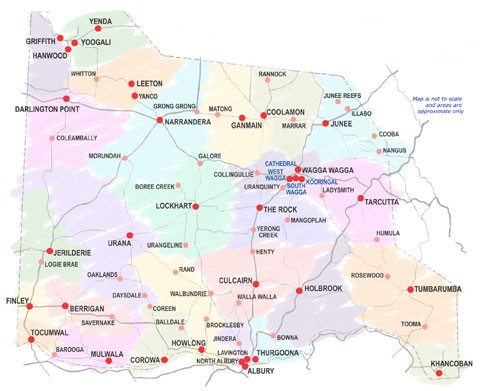
Located within Wiradjuri country in the Riverina and Yorta Yorta country in the southwestern district of New South Wales, the Diocese of Wagga Wagga stretches from Khancoban in the east to Griffith and Yenda in the west. Populated with both large and small towns, it is home to some of Australia’s richest and most picturesque countryside.
The Murray and Murrumbidgee Rivers are significant geographical features of the area with the eastern border of the Diocese lying in the mountainous regions of the Great Dividing Range.

Established in 1917, the Diocese of Wagga Wagga has a rich faith tradition; our faith communities are nourished and sustained by the sacramental life of the church administered and accessed through 31 parishes,  29 schools – 24 primary and 5 secondary, and support services offered by Centacare throughout the diocese.

Associated links

Catholic Education Diocese of Wagga Wagga
The Catholic Church in Australia
Caritas Australia
Catholic Missions
Commission for Australian Catholic Women
Catholic Earthcare Australia

Our Mission + Vision

Sharing the joy of gospel

We’re here to share the joy and love of Jesus with the people of the Riverina. Our Diocese exists to foster and equip our extended religious communities – parishes, schools and welfare services to carry out the mission of Christ in the world.

Our Bishop

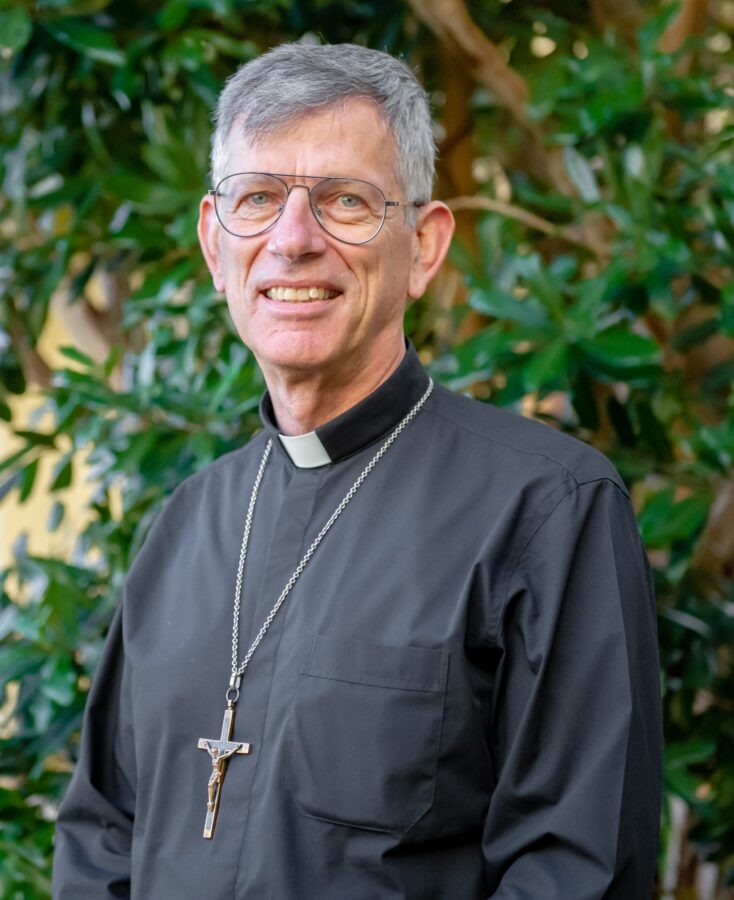
The Most Reverend Mark S Edwards OMI PhD DD,
Sixth Bishop of Wagga Wagga

Mark Stuart Edwards OMI was born in 1959 in Balikpapan on the island of Borneo in Indonesia the first child of Graham Edwards from Adelaide, who was working there in the oil industry, and his wife Christina (aka Tineke) from The Hague in Holland. They returned to Australia in 1962 and the family, to which were added in due course Keith, Karen (now Herford) and Donald, moved several times before settling in Melbourne in 1968. A parishioner of St Leonards in Glen Waverley and Holy Saviour, Vermont South, he attended Saint Leonard’s Primary School Glen Waverley and later Mazenod College, Mulgrave, where he made his first contact with the Congregation of the Missionary Oblates of Mary Immaculate who conducted the College.

He joined the Oblate novitiate in 1980 after completing a Bachelor of Science at Monash.  Mark received his academic priestly formation at Catholic Theological College of Melbourne, a college of the then Melbourne College of Divinity (now University of Divinity). After his priestly ordination on 16 August 1986, Father Edwards served as teacher at Mazenod College (1986-1989) and teacher at Iona College in Brisbane (1990-1997), returning to Saint Mary’s Seminary in Mulgrave as Postulant Master (1998-2004); as Novice Master (2004-2007) and as Rector (2007-2010). He was concurrently studying at Monash University for a PhD in Philosophy and a lecturer at Catholic Theological College in Melbourne (2005-2010). In the years 2001-2010, he served on the Provincial Council of the Australian province of the Missionary Oblates.

Fr Mark served as Rector of the Iona College in Lindum, Brisbane (2010-2014) until, on 17 December 2014, he was ordained to be titular Bishop of Garba and Auxiliary Bishop of Melbourne.  In Melbourne, Bishop Mark served as Auxiliary Bishop with pastoral responsibility in the Eastern Region and later in the Western Region.  He also supported the Archdiocesan Office for Youth and the Tertiary Chaplains in the Archdiocese. Whilst in Melbourne, he served on the Bishops Commissions for Catholic Education, for Family, Life and Youth and for the Plenary Council.

On 26 March, Pope Francis appointed Bishop Mark as 6th Bishop of Wagga Wagga in succession to Bishop Gerard Hanna who retired due to ill health in 2016. Bishop Edwards was received into the Diocese of Wagga Wagga at a Liturgical Reception and Solemn Mass held at St Michael’s Cathedral Wagga Wagga on 22nd July 2020.

Bishop Edwards continues to serve on the Bishops Commissions for Catholic Education and the Plenary Council, and the National Catholic Education Commission.

Pastoral letters

A Pastoral Letter on the new situation with the Society of St Pius X (SSPX)

A Pastoral Letter on the new situation with the Society of St Pius X (SSPX)

Explaining the SSPX Issue

Lent 2023

Sunday Obligation 2022

Hope Sunday 2021

Palliative Care Week 2021

Organisational Charts

Click a map to enlarge

Governance Chart

Evangelisation, outreach + pastoral care

  • Bishop
    The Bishop is entrusted by the Church to teach, sanctify and govern the Diocese. All diocesan offices, councils, agencies and ministries exercise their responsibilities under his authority. Some bodies assist him through advice, administration, consultation, or consent. Where consent is required, the Bishop cannot validly act without it. Where consultation is required, he must seek the body’s opinion but is not strictly bound by it, though he should not act against it without an overriding reason.
  • Trustees
    The Trustees of the Roman Catholic Church for the Diocese of Wagga Wagga are the civil legal body through which Church property is held and dealt with. The Trustees are constituted under the Roman Catholic Church Trust Property Act 1936. In canon law, property belongs to the relevant Church juridic person, such as the Diocese or a Parish. In civil law, the Trustees hold title, enter contracts and execute legal instruments on behalf of the Diocese and parishes. The Trustees are the Bishop and the members of the College of Consultors, but the two bodies act in different capacities, one civil, one canonical, and are not interchangeable.
  • Diocesan Finance Council
    The Diocesan Finance Council is required by canon law and assists the Bishop with financial and legal advice. Its members are experts in financial or legal matters. For acts of greater importance, the Bishop must consult the Finance Council. For acts of extraordinary administration, he cannot act validly without the consent of both the Finance Council and the College of Consultors.
  • Diocesan Financial Administrator
    The Diocesan Financial Administrator is responsible for the financial administration of the Diocese. In this Diocese, this role is carried out by the Chief Operating Officer. It is a canonically defined office, and its duties are set by universal canon law. The Diocesan Financial Administrator administers the temporal goods of the Diocese under the Bishop’s authority and in accordance with the budget determined by the Diocesan Finance Council. This mandate extends to all diocesan temporal goods, including the assets, income and expenditure of the Diocese and its agencies. The Diocesan Financial Administrator reports income and expenditure to the Diocesan Finance Council, presents annual budgets for review, and acts as the Bishop’s delegate in supervising parish administration.
  • Council of Priests
    The Council of Priests represents the presbyterate and assists the Bishop in the pastoral governance of the Diocese. It gives advice on matters affecting the pastoral life and mission of the local Church. On certain matters, the Bishop cannot act without at least hearing the Council.
  • Personnel Board
    The Personnel Board is an advisory body, not specifically mandated by canon law. It advises the Bishop on clergy appointments.
  • College of Consultors
    The College of Consultors is a small body of priests appointed by the Bishop from among the Council of Priests. Canon law requires the Bishop to consult the College on acts of greater importance, and to obtain its consent on others, especially in acts of extraordinary administration. In the event of a diocesan vacancy, the College governs the Diocese until a new Bishop is appointed or an Apostolic Administrator is named.
  • Vicar General
    The Vicar General is the principal deputy of the Bishop in the governance of the Diocese. He assists the Bishop in governing the whole Diocese and can carry out administrative acts with the same canonical effect as if they were carried out by the Bishop himself, except in matters reserved to the Bishop or requiring a special mandate.
  • Practical Example
    CEDWW may identify the need for a significant financial or administrative act, such as a major school development involving substantial capital expenditure and significant borrowing.
  • The value of the work is above the thresholds for extraordinary administration.
  • CEDWW prepares the proposal with the necessary background, rationale, financial information and risk assessment. The Chief Operating Officer, as Diocesan Financial Administrator, analyses the matter and presents it to the Diocesan Finance Council and the College of Consultors.
  • If the matter is an act of greater importance, the Bishop must hear the advice of both bodies. If it is an act of extraordinary administration, he must obtain the consent of both bodies.
  • The Bishop then makes the decision. If approved, CEDWW may proceed, with any necessary civil-law steps carried out through the Trustees or other delegated authorities.

Learn more or get involved

To get involved or explore our network of parishes, schools, and services, or find out how you can support the mission of our Diocese. For general enquiries, please call (02) 6937 0003 or email enquiries@wagga.catholic.org.au.

New edition every month

Together

Our Diocesan newspaper reports on issues of importance to the Catholic world as well as to the members of the parishes and schools of the community.